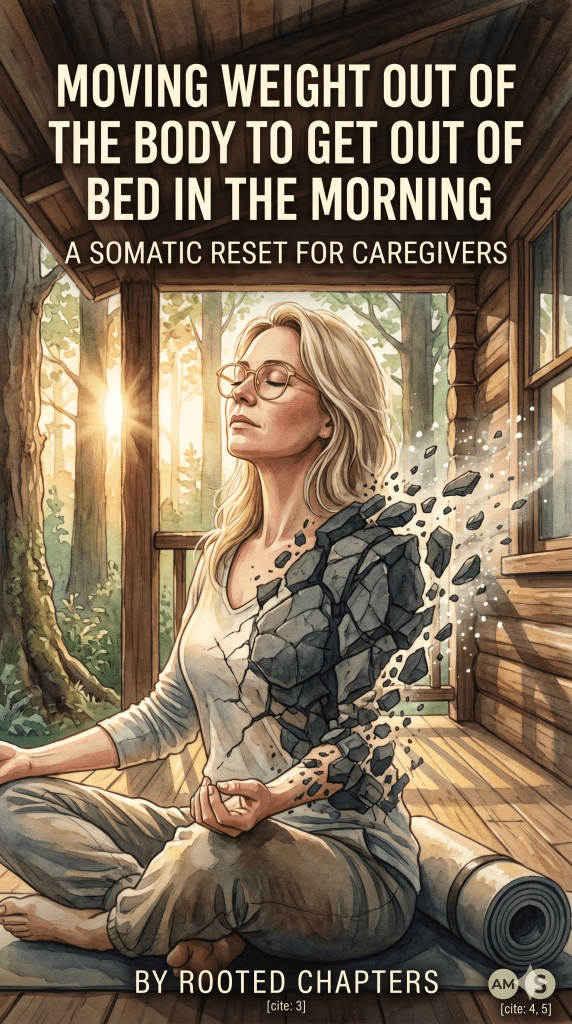
We are built to carry. Our bodies are incredibly resilient vessels, designed to absorb, adapt, and hold. They hold our history, our victories, our grief, and, all too often, the invisible weight of the world around us. For some of us, that load becomes too heavy. We build up to protect ourselves becomes the very thing that traps us, weighing us down until the simple act of waking up feels like an almost impossible task.
I know that feeling. For a long time, my mornings weren’t a new beginning; they were a battlefield. I would wake up and feel a literal physical density, a concrete-like heaviness that made it feel like my limbs were made of lead and my heart was encased in stone. Getting out of bed was an act of raw, grinding will. This wasn’t laziness; it was the physical manifestation of chronic overstimulation and a relentless battle with my mental health.
The world is loud. Every notification, every demand, every unfulfilled expectation adds another layer to that invisible weight. I was braced for impact, 24/7, and my nervous system had forgotten how to turn off the alarm.
This is where the concept of a somatic reset saved me.
I logically understood why I was feeling this way. But logic doesn’t speak the same language as the nervous system. The mind can analyze, but the body knows. It stores trauma and stress in the muscles, in the pattern of our breath, and in the tension of our fascia. To release that weight, I had to learn to speak to the body directly.
A somatic reset is, in essence, a dynamic intervention—a physical act designed to reset the baseline of the nervous system and actively move stagnant energy out of the body. It is the understanding that you cannot always “calm down” intellectually, but you can move the stress out physically.
Here is how I started to fight back, and how this methodology forms the backbone of the Somatic Reset pillar here at Rooted Chapters.
1. Disrupting the Static (Micro-Resets in Bed)
The battle begins before your feet even touch the floor. In those first paralyzing moments of waking up, when the world already feels too loud, I start small. A micro-reset doesn’t require anything complex; it requires disruption.
- Somatic Shaking: This is my most potent tool. While still lying down, I begin with small, vibrating movements in my hands and feet. I gradually let that shaking move up my limbs, intentionally “shaking off” the mental residue of the night and the sensory static of the morning. It’s an instinctive, animalistic way to discharge high-arousal energy.
- Tense and Release: I consciously tense every muscle group in my body for a few seconds—clenching my jaw, balling my fists, tensing my core—and then exhale dramatically, dropping the tension completely. This simple act teaches the nervous system the stark contrast between “on” and “off,” helping to dissolve the constant, low-level bracing.
2. Moving into the Quiet
The environment in which we try to heal matters profoundly. For me, trying to decompress in the same space where my overstimulation triggers are (the loud house, the domestic to-do lists, the digital notifications) is an uphill battle. The physical methodology of disconnection isn’t just a vacation; it’s a necessary boundary for somatic recovery.
Start as small, and quiet as possible. After I finish my morning ritual of bathroom tasks, I do what I call “waking up the house.” Which includes gently opening all the curtains to let the natural sunlight in. It’s a warm reminder that a new day has started, and I DO have things to be excited for.
3. Integrating Movement (The Sunrise Flow)
Then I integrate movement. For the overstimulated mind, highly disciplined or competitive exercise can feel like another demand. Somatic movement is different. It is restorative, intuitive, and designed purely for release.
- Living Room Yoga: Taking my yoga practice out of a studio and into my cozy home after the sun has come up is entirely different. There is no one watching, and no goal to achieve. The sequence is secondary to the sensation. I prioritize gentle, twisting movements that wring out tension from the spine, and deep, grounding poses that emphasize our connection to the physical earth. It is not about doing the pose; it is about feeling the body occupy it. Start with YouTube tutorials. I usually put on a quiet morning flow.
- Be intentional: take a full, unstructured breath. We match our breathing to the expansive view, allowing for a complete inhale and, more importantly, a slow, audible exhale—the primary signal to the parasympathetic nervous system that the crisis is over.
A somatic reset is not about “escaping” reality. It is about actively cultivating the resilience required to navigate it. We cannot always control the input, but we can master how we discharge the energy.
This practice didn’t eliminate my struggles, but it gave me a weapon. It gave me a way to fight for my mornings and to physically drop the armor. When you can actively move that weight out of your body, you are not just surviving; you are creating space for something new. You are allowing yourself to finally become rooted in your own skin, ready to begin again.


 Rooted
Leave a comment